
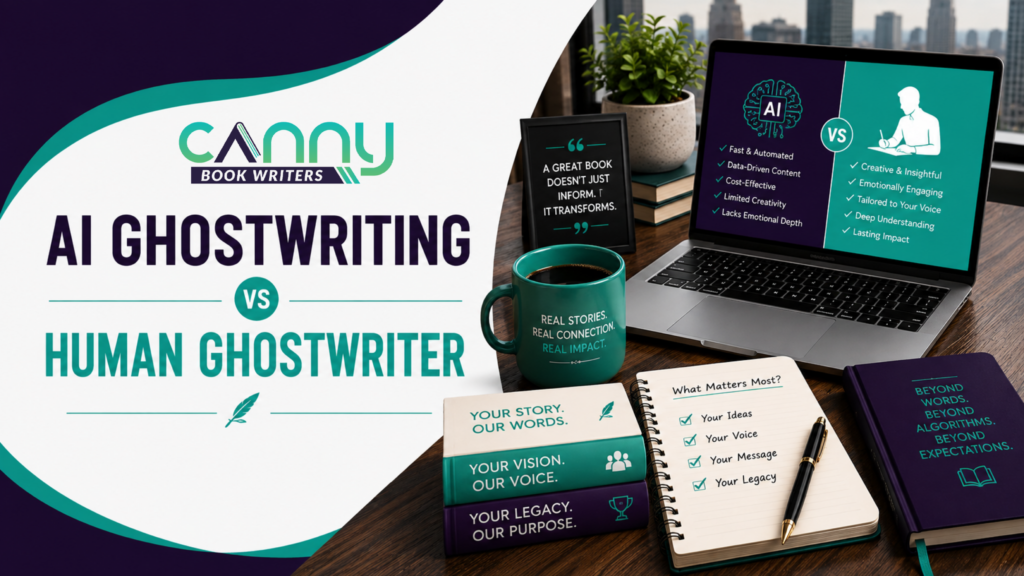
When AI can write out a complete draft in minutes, do you even need a human ghostwriter? That is what all half-baked book ideas are currently pondering. The real truth lies somewhere in the middle, and the only way to think about the AI vs human ghostwriting debate correctly would be to think about what each of them does well. Instead of deciding which side to pick, you are able to see the trade-off.
Will a human ghostwriter be completely replaced by AI by 2026? Not absolutely, but it has really altered the appearance of the initial steps of a book project. The activities of brainstorming, outlining, and rough first passes can now be done in hours rather than weeks. What has not changed so much is what comes after having this first draft, which is where much of the real value of a book is developed.
Here’s the roadmap. We will consider what AI tools really excel at, where human ghostwriters continue to play the biggest role, who is making this particular choice, and how to make the right choice in your particular project.
What “AI Ghostwriting” Actually Means Right Now
The term encompasses two vastly different things, and the beginning of the confusion is in the conflation of them. Complete AI ghostwriting tools produce a draft based on a prompt with minimal or no human editing of the text. Something quite different is a hybrid workflow: a human ghostwriter with AI as a brainstorming or first-pass drafting tool, within a professionally-managed editorial process.
The question of whether AI ghostwriting is worth it is virtually all about which of these two you actually compare to a process that is entirely human. Appendages to marketing text that are written by AI tool vendors seldom make such a clear distinction, and that is one of the reasons why consumers often find themselves at cross purposes as to what they are actually paying for, or attempting to do.
AI Tool vs. Hybrid Workflow vs. Full Human Ghostwriter
The three paths would have performed as follows on the two aspects which are most important, the authenticity of the final voice sound and the time required to reach it.
| Path | Voice Authenticity | Typical Timeline |
| AI tool only | Low to moderate, generic patterns, limited personalization | Days |
| Hybrid (human + AI-assisted drafting) | High, human shapes and edits AI-assisted drafts | 4–8 weeks |
| Full human ghostwriter | Highest, built around interviews and direct collaboration | 8–16 weeks |
The trend is simple. Human ghostwriter cost and schedule both increase with the extent to which your own voice and narrative must pass. A generic how-to manual is far more amenable to automation than a memoir will ever be, and that is precisely why comparing the idea of AI vs human book writing as a one-size-fits-all choice is a fallacy. It is not AI vs human book writing, it is what route corresponds to the particular book you are attempting to write.
Where Human Judgment Still Matters Most
In spite of the rapid advances of AI tools, some elements of writing a book still require a human presence in the room.
- Memoir, leadership and personal-development writing, emotional depth and nuance, where a prompt cannot be used to create lived experience.
- Structural choices which unite a whole book rather than a single paragraph in isolation.
- True voice-matching, which is effected by actual dialogue and interviews, not pattern generation, requires a sample of your writing.
- The editorial judgment that challenges the thought of an author, as opposed to merely reaffirming whatever direction he has begun to take.
- Responsibility and process control over a multi-month project, in which deadlines and changes require an individual to be vigilant in tracking them.
That is the gist of why AI ghostwriting sound authentic, being an open question where it comes to anything less than short-form or simply informational content. A tone can be reproduced to a reasonable degree by an AI tool when it is provided with a sample. It is much weaker in knowing which tales of a founder’s career really belong in chapter three as opposed to chapter seven, or when a chapter must slow down instead of summarize. The details of how this works with various genres can be found on our ghostwriting services page.
Who’s Actually Weighing This Decision
There are a couple of groups that are more likely to come up with this comparison, each having different priorities that caused the decision.
- Solopreneurs and consultants who desire a quick, inexpensive first draft to build upon, and who are willing to craft the final voice themselves.
- Memoirists and leadership writers require such emotional finesse that AI simply cannot recreate entirely by itself, despite the promptness.
- Hectic professionals who have to choose between an AI-supported DIY strategy and the option to outsource the whole process, which is typically due to a lack of time rather than money.
The first part of the answer is knowing what group you belong to, which comes up with most of the work in answering the question: Is AI ghostwriting worth your particular case? The needs of a solopreneur who is trying an idea are vastly different from those of a first-time author who is writing a memoir that is intended to be his or her name over the next ten years.
Choosing the Right Path for Your Project
The following is a step-by-step approach to the decision.
- Identify your genre. How-to or technical matter is where AI can and will engage more than a memoir or a leadership story will ever engage, because information is worth more than a voice.
- Determine the extent to which your personal voice and story should shine through, as opposed to the extent of the content which is common knowledge that could be told by anyone.
- Compare your budget to the real-life cost range per avenue, as the difference between an AI tool and a full human ghostwriter is significant and should be budgeted early.
- Consider your timeline. AI tools are the quickest; a full human ghostwriting job is the longest in terms of structure and voice.
- When you are picking a hybrid or human way, ensure that the actual process of the service to use AI responsibly is the actual process and not that a human-led process implies that AI is not involved at all.
All these factors are not to be evaluated separately. The combination of a tight budget and a memoir project, such as this, is an actual tension to name upfront, not to find three chapters into a hasty AI-only copy. When your project is more towards writing a longer and more organized manuscript, come to our ebook writing service page and see what the timeline actually looks like on paper, chapter by chapter.
When an AI Tool Alone Is Genuinely Enough
The candid antipathy to this is that it would be untrue to reject AI either.
The snapshots of lead, minor internal reports or brainstorming rough-drafts really do not require a complete human ghostwriting campaign behind them. When you require a speedy inside memo, a sketch outline in response to it, or a brief composition with no actual stakes tied to its veridicity, an AI ghostwriting tool alone is frequently the correct choice. It is quick, cheap and ideally suited to content on which voice is not working hard.
The error is not applying AI in this instance; it is thinking that the same shortcut is going to work with a full-length, publishable book. The same problem at different sizes does not exist between a 10-page lead magnet and a 200-page memoir. They are two totally different issues, and what works best with one does not always work best with the other.
Will Readers Be Able to Tell the Difference?
This is what the whole analogy is about, so it is worth mentioning.
AI-only text frequently sounds superficially sure but empty when a reader critically examines it, especially in any text that is intended to tell a personal narrative or have a particular point of view. Sentences are typically clean. What is usually missing is the specificity that would make a story seem to have happened to a specific person, and not a resultant compilation of similar stories that the model has read elsewhere.
Whether it is a hybrid or all-human process, the end product must be a manuscript that reads a lot like you, not like a well-structured overview of your broad subject. That is the real test to be put in place, not whether the prose is easy to read or not, but whether a close friend or a colleague can tell that it is your voice on the page without being informed who wrote it.
When hiring a service, enquire directly about how and where AI is applied in their process beforehand. Any provider who will not respond to that with clarity, or who will be evasive on details, is informing you of something worth listening to in its own right.
FAQs
Can AI actually write a full book on its own?
It is able to produce an entire draft, but the output will be less genre-focused, less emotional, and less structurally coherent, in particular.
Is a human ghostwriter worth the extra cost?
Yes, on the projects where voice and personal story count. In the case of low-stakes or purely informational content, an AI-assisted strategy can suffice.
Do professional ghostwriting services use AI at all?
A lot do, as a brainstorming or first-pass drafting tool, and a human author works on it, and then molds it and edits the final text.
How do I know if AI-generated content will sound authentic?
Inquire about the service, directly about the role and where AI fits in their process, and ask them to provide a sample chapter before deciding to do the entire project.
Conclusion
AI is a truly helpful resource in the ideation phase, accelerating brainstorming and rough-cuts in a fashion that had not been achievable a year or two prior. The organization, tone, and substance that enable a book to be worth reading after it is written are still the result of human judgment. The actual AI ghostwriter vs human ghostwriter choice is not on who is the winner, but rather what tool is applicable in which step of your particular project and being forthright with what your book actually requires.
Willing to discover the correct direction of your book? Place your order, and we will discuss it