
You have an excellent book idea. Maybe it is a business manual, an autobiography, or a practical how-to book based on years of experience. But weeks become months, and the writing is never begun at all, as the task seems daunting. A question is raised continuously: how long does it take to write a book? In the absence of a realistic timeline, the path from idea to publication may be so convoluted that it is better to defer than to do.
The fact is that all the published writers follow the same way. The process of writing a book is the same regardless of whether you are writing it or are utilizing the services of a professional book writing service, which consists of planning, drafting, editing, publishing, and promoting. The distinction is usually the effectiveness with which each step is accomplished.
This guide provides an honest, stage-by-stage look at the book writing timeline, comparing the DIY route with professional support so you know exactly what to expect from the idea to published book process.
What Is the Full Book Timeline, From Idea to Published Author?
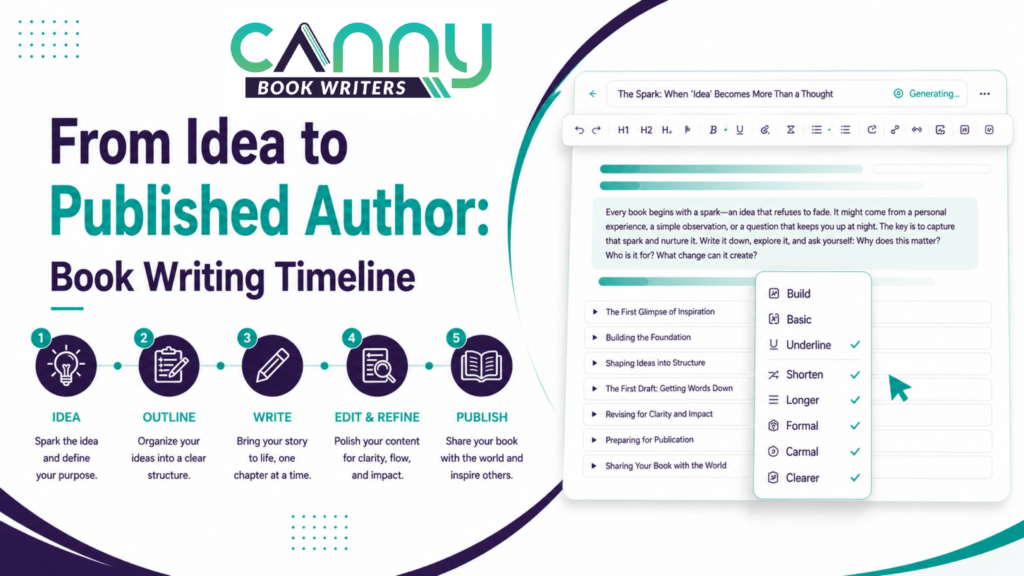
The overall book writing timeline consists of five major phases: brainstorming your idea and outline, writing the first draft, revision and editing of your writing, book design and formatting, and lastly publishing and marketing. Each project will proceed at its own pace, but when one is aware of these stages, planning the journey becomes simpler. In the sections below, we will discuss each step and compare realistic timeframes of independent writers and those who are collaborating with professional book writers.
DIY Timeline vs. Professionally Supported Timeline
Saving time in the process of drafting and editing is one of the greatest benefits of collaboration with seasoned writers. Whereas each manuscript is unique, the following comparison provides common timeframes of each approach.
| Stage | Typical DIY Timeline | With a Professional Writer |
| Outline & Concept | 2–4 weeks (often longer if direction changes) | 1–2 weeks through a guided discovery process |
| First Draft | 4–12 months, depending on writing schedule | 6–12 weeks with dedicated writing support |
| Editing & Revisions | 2–4 months using self-editing and beta readers | 3–6 weeks with professional editors |
Stage-by-Stage Breakdown
Stage 1: Outline and Concept.
Any successful book begins with a purpose. You have to determine what your book is about, who you are writing to, and what the readers will get out of it before you write even a single chapter. This is the base of the whole project.
A good outline will generally consist of your main point or idea, your audience, the structure of your chapters and the main points you will make in each chapter. It is also beneficial to spend some time here so that the confusion in the future is minimized and the manuscript is concentrated throughout.
The problem is that, unfortunately, that is where many DIY projects are halted as well. Authors are usually enthusiastic when starting their writing, but find it hard to put their ideas into a clear order. As they do not have a roadmap, they switch ideas, rewrite the initial chapters multiple times or even give up the project.
Before the writing of a book commences, a professional book writing service often starts with an extensive planning session to decide what you want to accomplish. Experienced writers will assist you in organizing your thoughts into a chapter-by-chapter outline with the aid of interviews and joint discussions that make the process of writing a lot more productive.
Stage 2: First Draft
The process of writing the first draft is typically the most challenging and time-consuming step of the process. To a person who is learning how to write a book, it can take one to four to eight months to write a complete book and at the same time to work, family and other personal commitments. Other writers have to take even more time, particularly when they revise each chapter as they go.
Consistency is not always the greatest difficulty, but writing ability is. Most novice writers do not adhere to a routine schedule of writing but wait until they are inspired. After a few weeks of nothing, the momentum wanes, and the paper is still not complete.
Stage 3: Editing, Proofreading and Revisions.
The most important thing is to complete your manuscript, and it does not mean the journey is over. No good book gets published without going through numerous editing stages before it is made available to the readers. This step is not to be underestimated, especially by first-time authors, but this step influences the quality of the final book the most.
The process of editing most often starts with the developmental, a form of editing concerned with the structure, pacing, organization, and general message of the book. Line editing enhances the readability, flow of the sentence, and consistency once the content is refined. Lastly, grammar, spelling, punctuation, and formatting mistakes are detected at the last stage before publication.
Even when it comes to independent authors, there are numerous ones who use the services of beta readers to receive honest feedback prior to the final version of the manuscript being published. New insights can shed light on ambiguous areas or holes that the author might have missed.
And, should you have a manuscript that you are ready to publish, our book editing services can assist in polishing your work and making it ready to be read.
Stage 4: Design, Formatting and Publishing
When you have finished editing, your book must be professionally presented. Cover is another judgment that readers make about a book; thus, this step is as significant as writing itself.
The publishing preparation process usually involves:
- Professional cover design
- Print and eBook versions: interior formatting.
- Final file preparation
- ISBN establishment (where necessary)
- Publication to online publishing, like Amazon KDP.
Traditional vs. self-publishing authors will also be required to write query letters and have a literary agent before approaching publishers. Although traditional publishing has a broader distribution base, it typically takes a year to three years, as a result of submission, acquisition, editing, and production phases.
Stage 5: Launch and Promotion
Publishing your book is an exciting achievement, but success doesn’t stop there. An intelligent launch strategy makes the readers learn about your work and creates a buzz in the initial few weeks after publication.
Basic promotional efforts involve making your release known on social media, gathering pre-release reviews, emailing your newsletter, setting up podcast interviews, and requesting readers to leave reviews online.
Marketing does not need to be difficult, but you should plan the marketing early so that your book can reach the audience for which it was written.
Where a Professional Writer Saves the Most Time
Hiring a professional book writing service does not mean the process of publishing is done away with, it just shortens the process significantly in areas that are slowest to most writers.
1. Completing the First Draft
The most significant challenge is normally the first draft. Professional writers have organized timelines that, in most cases, can cut months of labor into a few weeks of concentrated effort.
2. Structural Editing
Skilled editors have an eye to spot disorganization, pacing, and clarity problems that novice writers overlook. Early solution of these problems can avoid rewrites in the future.
3. Avoiding False Starts
Most books are left unfinished as authors keep on rewriting their outlines or become demotivated. Projects are kept on schedule to completion by a documented process, periodic milestones and professional responsibility.
Are you willing to shorten your publication time? Consider our ghostwriting services to understand how professional writers can assist your ideas to become a completed manuscript.
Frequently Asked Questions
How long does it actually take to write a book?
It can take six to twelve months to write and edit a book in most cases for first-time authors. That may be increased by larger projects or non-full-time writing schedules.
Does hiring a professional writer really save months?
Yes. Professional book authors adhere to workflow best practices that save a lot of time in drafting and editing, as well as produce quality work.
What is the fastest realistic timeline from idea to published book?
Many non-fiction books can go through concept to publication in about three to six months with the help of a clear outline, professional support and self-publishing.
How long does self-publishing take compared to traditional publishing?
After the finalization of the manuscript, self-publishing may be done in a few weeks. Conventional publishing will add between one and three years due to additions made by agent submissions, publisher schedules, and production timelines.
Can I speed up the editing stage without sacrificing quality?
Yes. The use of focused feedback from beta readers, hiring of experienced editors, and solving structural problems in advance of proofreading will reduce the time needed to edit and keep the editing process professional.
Conclusion
All books have a similar course of development: starting with an idea and an outline, then writing, editing, publishing, and marketing the finished one. Although all the stages are time and commitment-consuming, the realization of the process will ensure that the journey becomes much easier.
The greatest distinction between DIY writers and those who work with professional book writers is not often the publishing itself. Rather, time is saved the most in the drafting and editing processes, where organization, experience, and accountability are used to keep projects on track.
By contracting a professional book writing service, you have a realistic roadmap, expert advice and help to transform an idea into a finished manuscript. You will not ask yourself where to start, but rather have a clear plan that will assist in bringing your vision to a published book.
Find out how our book writing service can enable you to step confidently from your initial thought and become an author.